Kicking off with top 2 percent net worth us, we dive into the exclusive world of financial elite, where every dollar counts, and smart investing is the name of the game. Imagine being part of the 1.4 million households in the US that hold an astonishing 31% of the country’s wealth. These top 2 percent net worth individuals have achieved unparalleled financial security, tax benefits, and networking opportunities that set them apart from the rest.
But what drives their success? Is it their business acumen, investment savvy, or simply being at the right place at the right time?
From the historical context of the US tax code to the various strategies employed by the top 2 percent net worth earners, we’ll explore the intricacies of this exclusive club and what it takes to be part of it.
Historical Context of the Top 2 Percent Net Worth Club in the US
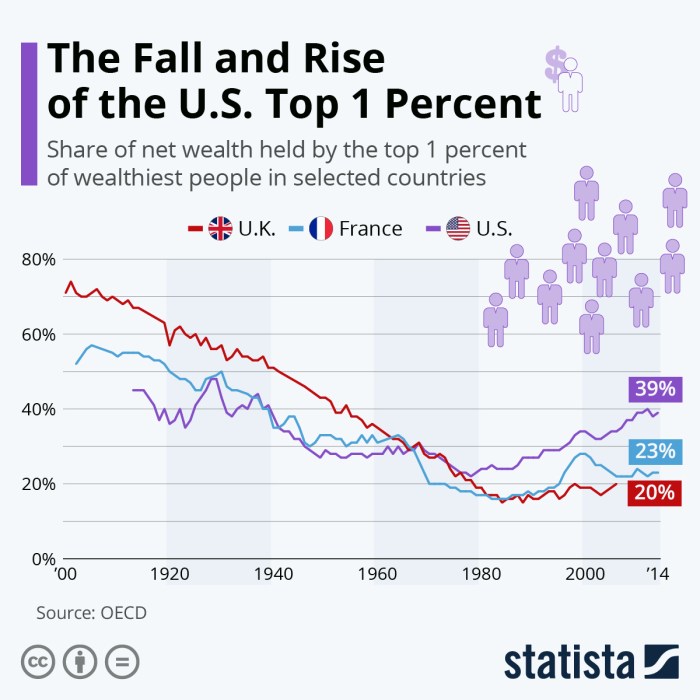
The emergence of the top 2 percent net worth club in the US is intricately linked to the evolution of the country’s tax code. Over time, successive legislative changes have created a complex system favoring the wealthy, ultimately giving rise to this exclusive club. In this historical context, we explore how these tax policies and laws have contributed to the phenomenon, tracing their development and impact.The post-WWI era saw the introduction of progressive taxation in the US, a concept championed by President Woodrow Wilson and implemented through the Revenue Act of 1913.
This legislation created a three-bracket system, taxing incomes between 1% and 7%. However, as the US economy continued to grow and prosper, the wealthy began to wield significant influence over tax policy.In the 1920s and 1930s, wealthy individuals and corporations exploited loopholes and deductions in the tax code, allowing them to minimize their tax burden. This strategy, known as “tax engineering,” became increasingly sophisticated, with the help of influential tax attorneys and politicians.
The Rise of Tax Loopholes and Deductions
Tax loopholes and deductions emerged as a primary means for the wealthy to reduce their tax liability. One key example is the formation of trusts, which enabled families to transfer wealth to future generations while minimizing estate taxes. Another notable example is the utilization of foreign tax havens, such as the Bahamas and Panama, which offered ultra-low tax rates and confidentiality agreements.
The 1981 Tax Act: A New Era of Favoritism
The 1981 Economic Recovery Tax Act, signed into law by President Ronald Reagan, marked a significant turning point in the evolution of the US tax code. This legislation introduced sweeping changes favoring the wealthy, including:
- Significant tax rate reductions for high-income individuals and corporations
- Introduction of the capital gains tax rate, set at 20%, for investors selling securities and real estate
- Expansion of the earned income tax credit for low- and moderate-income workers
- Creation of the Individual Retirement Account (IRA), allowing high-net-worth individuals to save for retirement while reducing their taxable income
The Enlargement of Tax Credits and Exemptions
The mid-20th century saw the introduction and expansion of various tax credits and exemptions, benefiting high-income households. For example:
- The Tax Reform Act of 1976 phased out the wealth transfer tax and increased the exemption threshold for the Alternative Minimum Tax (AMT)
- The Tax Act of 1981 expanded the mortgage interest deduction, making homeownership more accessible to high-income earners
- The Tax Reform of 1986 reduced the corporate tax rate, incentivizing corporate savings and investment
The Increasing Role of the IRS in Favors of the Wealthy
The Internal Revenue Service (IRS) has long been criticized for favoring the wealthy. The Reagan administration’s policies, in particular, led to a shift in the agency’s priorities, with a focus on auditing low-income taxpayers and overlooking the tax avoidance strategies employed by high-net-worth individuals.In recent years, this trend has continued, with high-profile tax avoidance cases involving prominent politicians and business leaders.
The Panama Papers leak in 2016 and the Paradise Papers in 2017 exposed widespread tax evasion using offshore accounts.
Modern-Day Repercussions of a Favored Tax Code
The historical context of the US tax code has given rise to a top 2 percent net worth club, characterized by:
- Unbridled wealth concentration, leading to growing economic inequality
- Reduced tax revenues, necessitating budget austerity and policy measures disproportionately affecting low-income and middle-class households
- Increasing reliance on private wealth management and wealth preservation strategies, such as tax-deferred retirement accounts and investment in luxury real estate
Today, the US tax code represents a stark departure from its original intent, favoring the interests of the wealthy over the broader public. As we move forward, it remains essential to reassess and reform our tax policies to ensure a fairer and more equitable society for all.
Defining the Top 2 Percent Net Worth Threshold: Top 2 Percent Net Worth Us

The top 2 percent net worth club in the US consists of individuals who possess a staggering amount of wealth, a benchmark that has been steadily increasing over the years. As of 2022, this threshold stands at approximately $11.3 million, leaving many to wonder how this figure is calculated and who among us might fit into this exclusive category.The net worth of an individual is determined by calculating the difference between their total assets and liabilities.
Assets include cash, investments, real estate, and other valuables, while liabilities include debts such as mortgages, credit cards, and loans. When it comes to the top 2 percent net worth threshold, the math gets a bit more complicated. A commonly used method for calculating net worth, known as the Federal Reserve’s Survey of Consumer Finances, uses the following formula:Net Worth = Total Assets – Total LiabilitiesFor instance, let’s consider a wealthy individual with the following assets and liabilities:Assets:* Primary residence worth $2 million
- Stocks and bonds worth $3 million
- Investment properties worth $1 million
- Cash and other valuables worth $1 million
Total Assets: $7 millionLiabilities:* Mortgage on primary residence worth $1 million
- Credit cards and personal loans worth $50,000
- Business loans worth $500,000
Total Liabilities: $1.05 millionUsing the above formula, this individual’s net worth would be:Net Worth = $7 million – $1.05 million = $5.95 millionBased on this calculation, this individual would just barely scrape into the top 2 percent net worth club. However, as we can see, the line between being in the top 2 percent and not quite making it is razor-thin.
Real-Life Examples of the Top 2 Percent Net Worth Club
Meet some of the most influential and successful individuals who have achieved the top 2 percent net worth threshold.
-
Billionaire Investors
Some of the most successful billionaire investors in the US have consistently been net worth members of the top 2 percent club. For instance, investor Carl Icahn’s net worth has consistently hovered above $17 billion, while fellow billionaire investor David Einhorn’s net worth has exceeded $1.5 billion. -
Entrepreneurial Success Stories
Not all members of the top 2 percent net worth club are billionaires, however. Many successful entrepreneurs have achieved net worths that exceed the $11.3 million threshold through a combination of hard work, smart investing, and strategic networking. For example, entrepreneur and philanthropist Richard Branson’s net worth has consistently exceeded $5 billion. -
Business Leaders and Executives
Top-tier business leaders and executives have also achieved the top 2 percent net worth threshold through a combination of salary, bonuses, stock options, and company stock ownership. For instance, the late business leader, Steve Jobs’ net worth was valued at $13.4 billion at the time of his death. -
Affluent Individuals in Various Fields
Individuals from various fields, including medicine, law, finance, and the arts, have achieved the top 2 percent net worth club through a combination of salary, bonuses, investments, and inheritances. For example, renowned surgeon Dr. Sanjay Gupta’s net worth has exceeded $50 million, while acclaimed artist Pablo Picasso’s net worth at the time of his death in 1973 was estimated at $600 million in today’s dollars.In conclusion, achieving the top 2 percent net worth threshold in the US requires a combination of wealth-generating strategies, business acumen, and a bit of luck. Meet the people who have achieved this exclusive club.
Income Distribution among the Top 2 Percent in the US
/images/2021/08/18/8a4d4aec-de97-4f84-8cd1-fbebe0b93ae4.png?w=700 "The Top 1% Net Worth Amounts By Age - Financial Samurai")
The Top 2 Percent in the US is a group of individuals who have accumulated a significant amount of wealth, but their income sources and investment strategies can vary greatly. While some may earn their wealth through traditional means such as salaries and bonuses, others may have built their fortunes through entrepreneurship, inheritance, or smart investments. In this section, we will delve into the different income sources, business endeavors, and employment backgrounds of the top 2 percent, providing a comprehensive picture of their financial diversity.
Investment Strategies, Top 2 percent net worth us
The top 2 percent in the US often employ various investment strategies to grow and maintain their wealth. Some common approaches include:
-
Stock Market Investments
Investors in the top 2 percent frequently invest in the stock market, either through direct ownership of companies or through mutual funds, exchange-traded funds (ETFs), or other investment vehicles. Blockbuster examples include Berkshire Hathaway, the insurance conglomerate led by Warren Buffett, and the private equity firm Blackstone Group, founded by Stephen Schwarzman.
-
Real Estate Investments
Real estate investments, such as property rental income, real estate investment trusts (REITs), or direct property ownership, are another popular strategy among the top 2 percent. For instance, the property mogul Donald Trump’s portfolio includes numerous luxury properties, such as the Plaza Hotel and the Trump Tower in Manhattan.
-
Alternative Investments
Alternative investments, including private equity, hedge funds, and venture capital, are also common in the top 2 percent’s investment portfolios. These investments often involve investing in private companies or funds that are not publicly traded, providing opportunities for higher returns but also involving higher risks.
-
Entrepreneurial Ventures
Many individuals in the top 2 percent have built their fortunes through successful entrepreneurial ventures, creating and growing businesses across various industries. Examples include Jeff Bezos, who founded Amazon, and Mark Zuckerberg, who co-founded Facebook.
Business Endeavors
The top 2 percent in the US often have a diverse range of business endeavors, from small startups to large corporations. Some common types of businesses include:
-
Technology and Software
Technology and software companies are a significant segment within the top 2 percent’s business portfolios. This includes companies like Apple, Google, and Microsoft, as well as smaller startups that have achieved significant success.
-
Finance and Banking
Finance and banking businesses, such as private equity firms, investment banks, and hedge funds, are also common among the top 2 percent. These firms often have a significant impact on the global economy and financial markets.
-
Retail and Consumer Goods
Retail and consumer goods companies, including luxury brands and high-end retailers, are another significant segment of the top 2 percent’s business portfolios. Examples include Louis Vuitton, Gucci, and the retail conglomerate Walmart.
-
Manufacturing and Industry
Manufacturing and industry businesses, such as aerospace, defense, and energy, are also represented in the top 2 percent’s portfolios. This includes companies like Boeing, Lockheed Martin, and ExxonMobil.
Employment Backgrounds
The top 2 percent in the US often have a strong professional background, with many having worked in top-tier firms or holding senior positions in their respective industries. Some common employment backgrounds include:
-
Wall Street and Investment Banking
Many individuals in the top 2 percent have a background in investment banking or have worked on Wall Street. This includes investment bankers, private equity professionals, and portfolio managers.
-
Law and Consulting
Law and consulting firms are another common employment background among the top 2 percent. This includes lawyers, consultants, and management consultants.
-
Technology and Software
Technology and software companies are also a significant source of employment for the top 2 percent. This includes software engineers, product managers, and tech entrepreneurs.
-
Finance and Private Equity
Finance and private equity firms, including hedge funds, private equity firms, and investment banks, are also a significant source of employment for the top 2 percent.
This section has provided a comprehensive overview of the income distribution, investment strategies, business endeavors, and employment backgrounds of the top 2 percent in the US. By understanding the various ways in which individuals accumulate and manage their wealth, we can gain a deeper appreciation for the complexities of wealth inequality in the US.
Comparing Top 2 Percent Wealth Management Strategies in the US

High net worth individuals in the US employ various wealth management strategies to maintain and grow their wealth. This section compares and contrasts different approaches, focusing on asset allocation, diversification techniques, and financial planning methods.
Asset Allocation Strategies
Asset allocation is a critical component of wealth management, as it determines how investments are distributed among different asset classes, such as stocks, bonds, and real estate. The top 2 percent net worth individuals in the US often employ the following asset allocation strategies:
Strategy Description Advantages Disadvantages Value Investing Purchase undervalued stocks with long-term growth potential High returns, reduced volatility Risk of value investing is higher Index Fund Investing Mirrors market performance by tracking a specific index Low costs, diversified portfolio No opportunity to outperform market Real Estate Investment Trusts (REITs) Invest in rental properties or direct ownership of real estate Diversified income, potential for long-term appreciation Risk of market fluctuations, illiquidity Diversification Techniques
Diversification involves spreading investments across different asset classes to minimize risk and maximize returns. Top 2 percent net worth individuals in the US often employ the following diversification techniques:
-
Creating a balanced portfolio: Allocating investments across different asset classes, such as stocks, bonds, and real estate, to reduce risk and enhance returns.
-
Using derivatives: Incorporating financial instruments, such as options and futures, to hedge against market volatility and optimize returns.
-
Investing in alternative assets: Exploring non-traditional investments, such as private equity, hedge funds, or cryptocurrencies, to add diversity to a portfolio.
Financial Planning Methods
A comprehensive wealth management strategy must include financial planning methods that address long-term goals, tax implications, and risk management. Top 2 percent net worth individuals in the US often employ the following financial planning methods:
The 4% Rule: Withdraw 4% of retirement portfolio annually to maintain purchasing power without depleting the principal.
Tax-loss harvesting: Offset capital gains by selling losing positions and using the losses to reduce tax liability.
Estate planning: Create a trust or will to transfer wealth to future generations while minimizing taxes and avoiding probate.
User Queries
Q1: What is the current threshold for the top 2 percent net worth in the US?
The current threshold for the top 2 percent net worth in the US is $1,300,000, according to a recent study by the Economic Policy Institute.
Q2: How do top 2 percent net worth individuals manage their wealth?
Top 2 percent net worth individuals often employ a combination of asset allocation, diversification, and tax planning strategies to manage their wealth. They may also invest in real estate, stocks, bonds, and other alternative assets.
Q3: What are some common tax planning strategies used by top 2 percent net worth earners?
Top 2 percent net worth earners may use charitable donations, tax-deferred retirement planning, and tax-loss harvesting techniques to minimize their tax liability.
Q4: How does the US tax code contribute to the emergence of the top 2 percent net worth club?
The US tax code has historically favored the wealthy, with progressive taxation rates and various deductions and exemptions available to high-income earners. This has contributed to the concentration of wealth among the top 1% of earners.
-
