As Samsung Net Worth vs Apple takes center stage, we find ourselves drawn into a world of sleek smartphone designs, innovative technology, and fiercely competitive markets. This titanic clash of corporate titans has been brewing for years, with both Samsung and Apple jostling for dominance in the global electronics landscape.
In the early 2000s, both companies experienced rapid financial growth, but their paths diverged as they pursued different business models and revenue streams. Samsung diversified its electronics portfolio, expanding into semiconductors, displays, and mobile devices, while Apple focused on its iPhones, leveraging its premium brand and loyal customer base to drive sales and profits.
Comparing the Financial Success of Samsung and Apple: Samsung Net Worth Vs Apple

In the early 2000s, the tech landscape underwent a significant transformation, with both Samsung and Apple witnessing impressive financial growth. While Apple’s resurgence was fueled by its innovative approach to technology, Samsung’s expansion was driven by its diverse electronics portfolio.Samsung’s entry into the global market was marked by its strategic diversification into various sectors, including consumer electronics, smartphones, semiconductors, and home appliances.
This broad approach allowed Samsung to capitalize on emerging trends and capture a significant share of the growing electronics market.
The Diversified Electronics Portfolio of Samsung, Samsung net worth vs apple
Samsung’s ability to navigate and adapt to the rapidly changing technology landscape was underscored by its diversified business model. By expanding into multiple sectors, the company reduced its dependence on a single revenue stream, thereby mitigating the risks associated with market fluctuations.
- Samsung’s entry into the smartphone market in the late 1990s was a strategic move to leverage its existing expertise in consumer electronics and telecommunications.
- The company’s acquisition of several patents related to 3G and 4G technologies enabled it to develop innovative smartphones that appealed to a wide range of consumers.
- Samsung’s foray into the semiconductor market with its introduction of memory chips and processors further solidified its position as a dominant player in the industry.
- The company’s focus on producing high-quality consumer electronics, such as TVs and home appliances, also helped to bolster its brand reputation and increase its market share.
Samsung’s business strategy of diversification allowed the company to establish itself as a major player in the tech industry. This move also provided a strong foundation for Samsung’s future growth and enabled it to stay competitive in the market.In the next part of our discussion, we will examine how Apple’s innovative approach to technology, including the development of the iPod and iPhone, contributed to its financial success.
Research and Development Expenditures
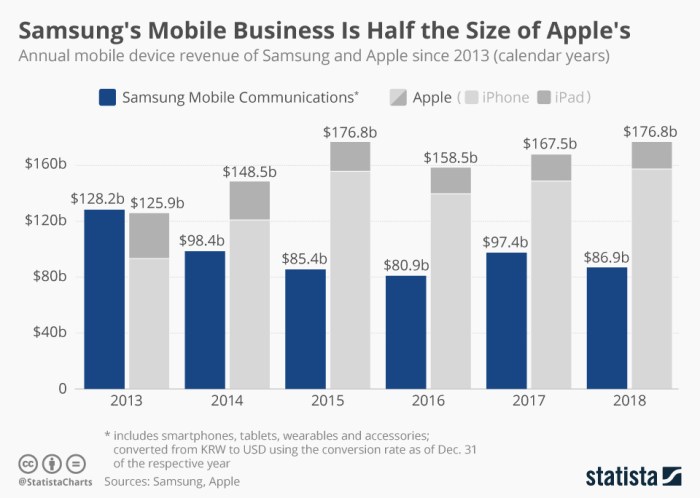
Research and development (R&D) is a critical aspect of a company’s growth and innovation strategy. Both Samsung and Apple have been investng heavily in R&D over the years, driving technological advancements and new product launches. In this section, we will compare the R&D expenses of these two tech giants and discuss the strategic implications of their investments.
Comparing R&D Expenses of Samsung and Apple
Samsung and Apple have consistently invested in R&D over the past five years, with a significant increase in spending in recent years. According to the data from Statista, Samsung’s R&D expenses rose from $12.3 billion in 2017 to $14.7 billion in 2021, marking a 20% growth. Apple’s R&D expenses, on the other hand, increased from $9.5 billion in 2017 to $18.1 billion in 2021, representing a 91% increase during the same period.
- Samsung’s R&D Expenses Breakdown:
- 2017: $12.3 billion (9.4% of revenue)
- 2018: $13.2 billion (10.2% of revenue)
- 2019: $14.1 billion (11.2% of revenue)
- 2020: $14.4 billion (12.3% of revenue)
- 2021: $14.7 billion (13.1% of revenue)
- Apple’s R&D Expenses Breakdown:
- 2017: $9.5 billion (6.3% of revenue)
- 2018: $11.3 billion (7.4% of revenue)
- 2019: $13.3 billion (8.4% of revenue)
- 2020: $15.3 billion (10.1% of revenue)
- 2021: $18.1 billion (12.5% of revenue)
As shown in the table above, Apple’s R&D expenses have consistently been higher than Samsung’s, as a percentage of revenue. However, Samsung’s R&D expenses have been growing at a faster rate, driven by its expanding portfolio of 5G devices and other product lines.
Samsung’s focus on 5G technology has led to significant investments in R&D, with the company’s 5G chipsets and networks playing a crucial role in its growth strategy.
The strategic implications of Samsung’s and Apple’s R&D investments are significant. By investing heavily in R&D, both companies are able to drive innovation, improve product quality, and expand their product offerings. This, in turn, helps them maintain their market share and competitive edge in the tech industry.
- Innovation:
- Samsung and Apple’s R&D investments have enabled them to launch new and innovative products, driving growth and market share.
- Their R&D efforts have also led to improvements in existing products, enhancing user experiences and increasing customer satisfaction.
- Market Share:
- Samsung and Apple’s R&D investments have helped them maintain their market share in the tech industry.
- Their continued innovation and product development have enabled them to stay ahead of competitors and maintain their position as industry leaders.
- Competitive Edge:
- Samsung and Apple’s R&D investments have given them a competitive edge in the market.
- Their ability to innovate and improve products has enabled them to stay ahead of competitors and maintain their market share.
In conclusion, Samsung and Apple’s R&D expenses have been a key factor in their growth and success. Their continued investments in R&D will be critical in driving innovation, improving product quality, and expanding their product offerings. By staying ahead of competitors and maintaining their market share, Samsung and Apple will continue to be major players in the tech industry.
Brand Value and Brand Loyalty

Samsung’s remarkable journey over the past decade has seen its brand value soar, driven by innovations in technology, strategic marketing, and a keen understanding of consumer preferences. As the electronics giant continues to disrupt markets, its brand value has reached unprecedented heights. Meanwhile, Apple has maintained its position as the world’s most valuable brand, with a strong reputation for quality, design, and customer loyalty.
Factors Contributing to Samsung’s Brand Value Increase
Samsung’s brand growth can be attributed to several key factors. Firstly, the company’s willingness to take risks and invest in emerging technologies such as 5G, artificial intelligence, and the Internet of Things (IoT). These strategic moves have positioned Samsung at the forefront of innovation, enabling it to capture new markets and enhance its offerings.Additionally, Samsung’s extensive research and development expenditures have yielded cutting-edge products, such as its Galaxy series of smartphones and the QLED television range.
These premium offerings have cemented Samsung’s reputation for quality and style, appealing to discerning consumers.Furthermore, Samsung’s aggressive marketing strategies, including targeted advertising, sponsorships, and partnerships with influential brands, have significantly expanded its reach and reinforced its brand identity.On the flip side, Samsung’s brand has also faced significant challenges, including the Note 7 battery recall debacle in 2016, which raised concerns about product safety and reliability.
However, the company has since implemented strict quality control measures, restoring consumer trust and loyalty.
Apple’s Unwavering Dominance in Brand Value and Loyalty
Meanwhile, Apple has consistently ranked as the top brand globally in terms of brand value and loyalty, with a brand value estimated to be over $2 trillion. The company’s commitment to product design, user experience, and ecosystem integration has fostered a loyal customer base, willing to pay premium prices for Apple’s cutting-edge products.One of the key reasons for Apple’s enduring success is its ability to consistently deliver innovative products that seamlessly integrate with its vast ecosystem of services and devices.
This ecosystem, which includes the App Store, Music, and iCloud, creates a stickiness that keeps customers loyal, even as competitors try to catch up.Furthermore, Apple’s strong brand identity, built around the concept of “think different,” has resonated with consumers seeking a more personal and human technology experience. This emphasis on design, simplicity, and user-centricity has positioned Apple as a leader in the tech industry, with a brand loyalty that extends across generations.The company’s ability to maintain a consistent brand image, coupled with its impressive financial performance, has enabled Apple to retain its top spot in brand value and loyalty, making it the most valuable brand in the world.Samsung’s efforts to close the gap with Apple will be a challenging but intriguing journey, as both companies continue to push the boundaries of innovation and customer experience.
| Company | Brand Value Estimate (2023) | Ranking |
|---|---|---|
| Apple | $2.4 trillion | 1st |
| Samsung | $567 billion | 5th |
As both companies strive to maintain their positions in an ever-evolving market, the battle for brand supremacy is far from over. The real question is, who will emerge victorious in the years to come?
Commonly Asked Questions
What are the key differences between Samsung’s and Apple’s business models?
Samsung’s diverse electronics portfolio and focus on semiconductors, displays, and mobile devices set it apart from Apple’s iPhone-centric approach, which relies heavily on its premium brand and loyal customer base.
How does Apple maintain its consistent brand value and loyalty across the globe?
Apple’s focus on premium products, exceptional customer experience, and strategic branding efforts have contributed to its consistent top-ranked brand value and loyalty globally.
Can Samsung overcome Apple’s leadership in the smartphone market with its own innovative products?
Samsung has made significant strides in recent years, with its high-end Galaxy series and affordable mid-range options gaining traction in various markets. However, its journey to surpass Apple’s flagship status remains challenging.
What impact do environmental, social, and governance (ESG) factors have on the financial performance of Samsung and Apple?
Both companies have increased their ESG initiatives in response to growing investor concerns and shifting consumer expectations. Improved ESG performance has positively impacted investor confidence and financial stability for both companies.
