Imagine a world where the wealthy few hold a disproportionate share of the wealth, while the majority struggle to make ends meet. This is the harsh reality of net wealth percentile, a concept that refers to the distribution of wealth among individuals and households. Net wealth percentile is a hot topic in modern economies, with far-reaching implications for household finance decisions, economic growth, and national prosperity.
In this context, we’ll delve into the world of net wealth percentile, exploring its significance, measurement, and impact on global economies.
Net wealth percentile is a crucial indicator of economic health, revealing whether wealth is concentrated among the rich or more evenly distributed. It’s calculated using various indices and metrics, such as GDP, GDP per capita, and income per capita, which provide insights into the wealth distribution patterns. By analyzing historical data and statistical models, we can understand the causal relationship between technological advancements, automation, and labor shifts on net worth percentile.
We’ll also examine how different countries and regions compare in terms of net wealth percentile, GDP per capita, and poverty rate, highlighting the implications of economic policies, institutional frameworks, and cultural factors on wealth distribution.
Defining Net Worth Percentile and its Significance in Modern Economies: Net Wealth Percentile
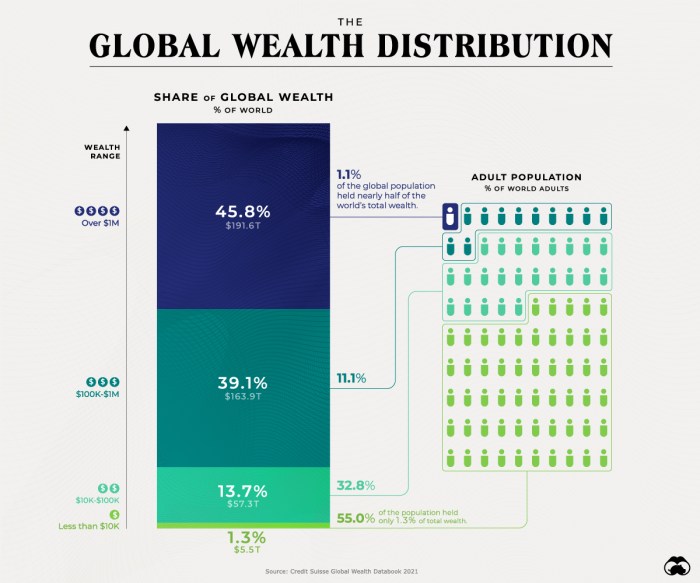
The concept of net worth percentile has become increasingly relevant in modern economies, serving as a powerful tool for understanding the financial landscape of households and the broader implications of wealth concentration and inequality. In this context, net worth percentile refers to the position of an individual or household within a distribution of net worth, a metric that encompasses all assets minus liabilities.
As we delve into the significance of net worth percentile, it becomes apparent that it has far-reaching implications for household finance decisions and budgeting strategies.Net worth percentile affects household finance decisions by influencing the allocation of resources and investment strategies. Households with a higher net worth percentile are generally more financially stable and confident in their ability to weather economic shocks.
In contrast, those with lower net worth percentiles may be forced to rely on debt or other high-risk financial instruments to make ends meet. The concentration of wealth among high-net-worth households can lead to reduced economic mobility and exacerbate existing inequalities, as those who are already wealthy are better positioned to take advantage of investment opportunities and accumulate even greater wealth.
Relationship between Net Worth Percentile and Individual Financial Stability
A key aspect of net worth percentile is its correlation with individual financial stability. Wealth distribution and economic growth are intimately linked, with more equitable wealth distribution contributing to sustained economic growth. The current economic landscape, characterized by widening wealth disparities and declining economic mobility, highlights the need for policies that promote greater economic equality and financial stability.The relationship between net worth percentile and individual financial stability can be observed through the following points:
- Financial stability is closely tied to net worth percentile, with higher-net-worth households exhibiting greater financial resilience and lower net-worth households facing greater financial risk.
- Unequal wealth distribution can lead to decreased economic mobility, as those who are already wealthy are more likely to have access to investment opportunities and accumulate greater wealth.
- Economic growth is heavily dependent on consumer spending, which is influenced by household financial stability and net worth percentile.
- Policies that promote greater economic equality, such as progressive taxation and increased access to education and job training programs, can help reduce wealth disparities and improve overall financial stability.
- The concentration of wealth among high-net-worth households can lead to reduced economic activity and stagnation, as the wealthy tend to save and invest rather than spend their wealth.
A notable example of the connection between net worth percentile and economic growth is the United States’ post-World War II economic boom. Following the war, the government implemented policies aimed at promoting economic equality, such as progressive taxation and increased access to education and job training programs. These policies contributed to a significant reduction in wealth disparities and a marked increase in economic mobility, leading to sustained economic growth and a period of unprecedented prosperity.
Wealth Concentration and Inequality
The concentration of wealth among high-net-worth households is a pressing concern, with significant implications for both individual financial stability and overall economic growth. As net worth percentile becomes increasingly skewed towards the wealthy, the economic landscape shifts in favor of those who are already well-positioned to accumulate greater wealth.The relationship between wealth concentration and inequality can be observed through the following points:
- Wealth concentration is often accompanied by reduced economic mobility, as those who are already wealthy are more likely to have access to investment opportunities and accumulate even greater wealth.
- The concentration of wealth can lead to decreased tax revenue, as high-net-worth households are often able to minimize their tax burden through various means.
- Wealth concentration can also lead to reduced social cohesion, as those who are already wealthy are often better positioned to take advantage of exclusive social and economic opportunities.
- Policies aimed at reducing wealth concentration, such as progressive taxation and increased access to education and job training programs, can help promote greater economic equality and improve overall financial stability.
The concept of net worth percentile is a powerful tool for understanding the complex relationships between household finance decisions, budgeting strategies, and the broader economic landscape. By examining the relationship between net worth percentile and individual financial stability, as well as the implications of wealth concentration and inequality, we can better understand the challenges facing modern economies and develop more effective policies aimed at promoting greater economic equality and financial stability.
Measuring Net Worth Percentile through Various Indices and Metrics

Determining an individual’s financial health is not always a straightforward task, as various factors such as income, expenses, and debt contribute to their net worth. Moreover, net worth percentile calculations can provide valuable insights into the overall economic landscape. By leveraging comprehensive indices and metrics, policymakers and financial analysts can gain a deeper understanding of the factors influencing an individual’s net worth.Measuring net worth percentile through various indices such as GDP, GDP per capita, and income per capita is crucial for comprehensive economic analysis.
These indices serve as benchmarks for evaluating an individual’s or household’s financial standing. For instance, GDP per capita calculates the gross domestic product of a nation by dividing it by its total population, providing an indication of the average standard of living within a country.The methodologies employed in calculating net worth percentile rely on comprehensive data sources like census surveys, national income accounts, and household expenditure surveys.
For example, the Bureau of Labor Statistics in the United States conducts surveys to gather data on household finances, which is used to calculate the disposable income of households.
Net Worth Percentile Metrics
Net worth percentile metrics account for demographic factors such as age, income level, and education, providing a more nuanced understanding of an individual’s financial health. For instance, the 90th percentile of household net worth indicates that 90% of households have a net worth below that specific level. The 10th percentile, conversely, indicates that 10% of households have a net worth below that point.Net worth metrics can be computed using the following mathematical formula:Net Worth = Total Assets – Total LiabilitiesWhere Total Assets refers to the sum of all assets owned, including cash, stocks, bonds, real estate, and other financial instruments.
Total Liabilities represents the sum of all outstanding debts, including mortgages, credit card debt, and other forms of borrowing.In the real-world economic scenario, the median household net worth in the United States was around $121,700 in 2020, according to data from the Federal Reserve. This indicates that 50% of households have a net worth above this value, while the other 50% have a net worth below it.
Accounting for Demographic Factors
To account for demographic factors such as age, income level, and education, various metrics can be applied. For instance, the Gini coefficient is a commonly used metric for income inequality, which can also be applied to net worth data. A lower Gini coefficient indicates greater equality in net worth distribution, while a higher coefficient suggests greater disparities.Net worth can also be influenced by factors such as education and occupation, which affect an individual’s earning potential and debt accumulation.
For instance, individuals with higher education levels often have access to better-paying job opportunities, leading to higher net worth.
Real-World Applications, Net wealth percentile
Net worth percentile metrics have real-world applications in the field of economics and finance. For example, policymakers can use these metrics to design targeted interventions aimed at bridging the wealth gap between different demographic groups. Financial institutions can also use net worth data to assess creditworthiness and develop targeted financial products and services.In conclusion, net worth percentile calculations through various indices and metrics provide valuable insights into an individual’s financial health.
By accounting for demographic factors such as age, income level, and education, policymakers and financial analysts can develop targeted interventions to promote financial inclusion and reduce economic disparities.
| Household Net Worth (in \$1000s) | Age Group | Education Level |
|---|---|---|
| 121.7 | 25-34 | Bachelor’s degree or higher |
| 71.4 | 35-44 | High school diploma or equivalent |
| 41.9 | 45-54 |
In the table above, we see a snapshot of net worth percentile metrics for different age groups and education levels in the United States. We can observe that households with higher education levels tend to have higher net worth, while households with lower education levels have lower net worth. These findings highlight the importance of education in determining an individual’s earning potential and net worth.
Future Trends and Challenges in Shaping Net Worth Percentile Dynamics

As the economy continues to evolve, the distribution of net worth among individuals is expected to undergo significant changes. Emerging trends such as the gig economy, universal basic income, and sustainable investing are poised to reshape the landscape of net worth percentile dynamics. In this context, experts predict that the future of work will be characterized by increased flexibility and autonomy, but also increased income inequality.The gig economy, for instance, is expected to continue its upward trajectory, with an estimated 36% of the US workforce engaged in non-traditional work arrangements by 2025 (
Source: Gallup, “The State of the American Workplace 2022”
). This shift towards freelance and contract work is likely to exacerbate existing income disparities, as those with the skills and resources to compete in the gig economy are expected to reap the benefits, while those who do not will be left behind. As a result, policymakers will need to grapple with the challenge of ensuring that the benefits of the gig economy are shared equitably among all segments of society.
The Rise of Universal Basic Income
Universal basic income (UBI) has gained significant traction in recent years, with several countries and cities conducting experiments to test its effectiveness. Proponents of UBI argue that it can provide a vital safety net for the most vulnerable members of society, ensuring that everyone has access to a basic level of economic security. In terms of net worth percentile dynamics, UBI could potentially lead to a more even distribution of wealth, as everyone would have access to a basic income, regardless of their employment status.However, critics argue that UBI could lead to a decrease in work incentives, as people may not feel motivated to work if they are receiving a basic income regardless of their employment status.
This raises questions about the long-term sustainability of UBI and its potential impact on the labor market.
Sustainable Investing and ESG Considerations
Sustainable investing has grown rapidly in recent years, with an estimated $35.3 trillion in assets now managed according to Environmental, Social, and Governance (ESG) criteria (
Source: Global Sustainable Investment Alliance, “Global Sustainable Investment Review 2020”
). As more investors prioritize ESG considerations, there is a growing expectation that companies will prioritize social and environmental responsibility alongside financial performance. This shift is likely to lead to increased transparency and accountability among companies, which could in turn contribute to a more equitable distribution of wealth.
Recommendations for Policymakers and Businesses
In order to address the challenges and opportunities presented by shifting net worth percentile trends, policymakers and businesses will need to take a proactive approach to ensuring that the benefits of the gig economy, UBI, and sustainable investing are shared equitably among all segments of society. Some potential recommendations include:* Implementing policies to address the needs of gig workers, such as access to healthcare, paid time off, and retirement savings plans.
- Conducting thorough impact assessments to evaluate the effectiveness of UBI experiments and making adjustments as needed.
- Integrating ESG considerations into business decision-making processes and prioritizing transparency and accountability.
- Encouraging education and retraining programs to help workers develop the skills they need to succeed in the gig economy.
FAQ Compilation
What is net wealth percentile, and why is it important?
Net wealth percentile refers to the distribution of wealth among individuals and households, measured by indices and metrics such as GDP, GDP per capita, and income per capita. It’s crucial for understanding economic health, household finance decisions, and national prosperity.
How does technological advancement affect net wealth percentile?
The impact of technological advancements on net wealth percentile is complex, with automation and labor shifts potentially exacerbating wealth inequality. However, successful innovation-driven economic growth can also promote net worth equality and prosperity.
What strategies can promote net worth equality and economic growth?
Inclusive economic growth, social welfare, and sustainable development are essential for promoting net worth equality and economic growth. This can be achieved through education, job training, and targeted policies to address wealth inequality and poverty.
How can policymakers address the challenges of net wealth percentile?
Policymakers can address the challenges of net wealth percentile by designing policies that promote inclusive economic growth, social welfare, and sustainable development. This includes education and job training programs, progressive taxation, and social safety nets to address poverty and wealth inequality.
